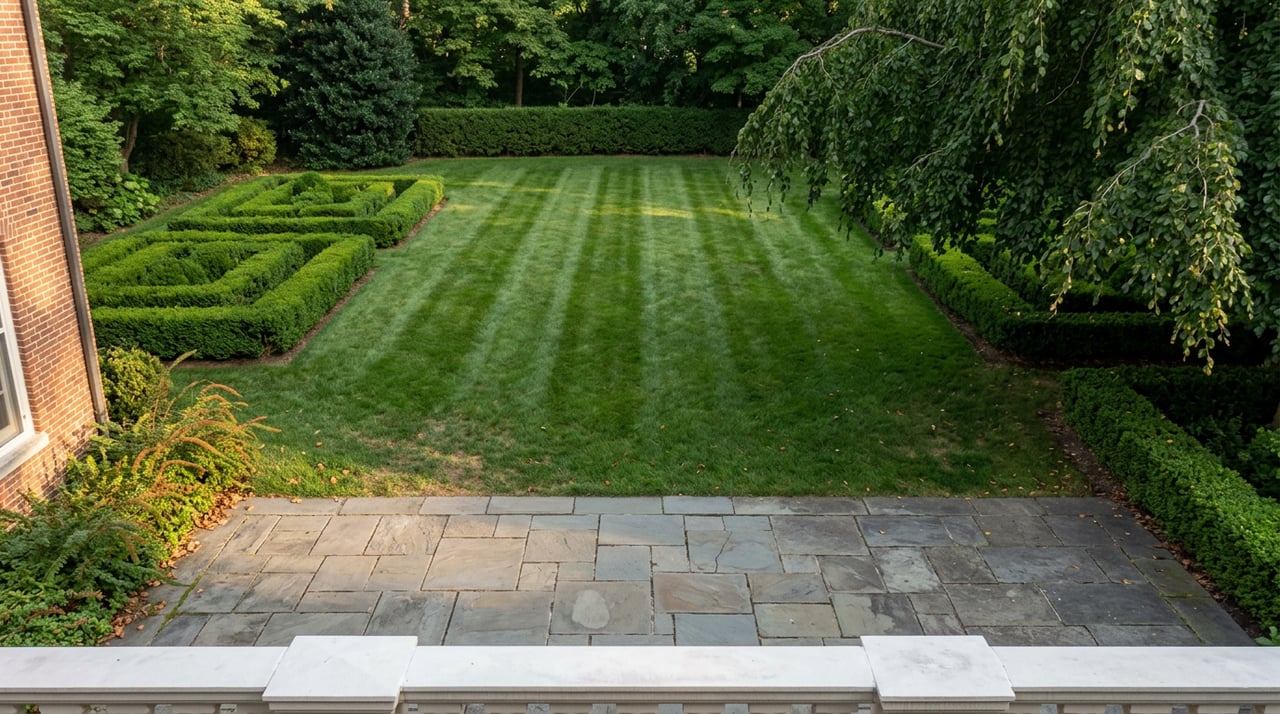
Homeland Doesn't Have a Clubhouse. It Has Six Lakes Instead.
August 27, 2026
August 27, 2026
Drive through most of Baltimore's planned communities from the 1920s and you'll eventually pass a community building. A meeting hall, a pool house, something with a roof and a mailbox where the neighborhood association keeps its records and hosts its potlucks. Homeland doesn't have one. It never built one. Instead, the Homeland Association runs the neighborhood's business out of members' living rooms and, once a year, a borrowed sanctuary at the Church of the Redeemer, while nearly every recurring tradition the neighborhood is known for happens outdoors, along the edges of six man-made lakes strung down Springlake Way.
That absence is not an oversight. It shapes how the neighborhood actually functions this time of year, and it's the reason a September evening in Homeland looks completely different from a September evening in a neighborhood built around a rec center.
The lakes predate the neighborhood by more than eighty years. When David Maulden Perine bought the property in the mid-1800s and named it Homeland, he ran it as a working farm and had a chain of six ornamental lakes dug in 1843 along a natural hollow, fed by a 2,100-foot conduit running from the estate's head springs. One of those ponds got an informal name that stuck: Banjo Pond, for its shape. That detail alone tells you something most new residents don't expect. The lakes weren't landscaping added after the houses went up. They were the site's defining feature more than eight decades before the Roland Park Company bought the estate in 1924 and brought in the Olmsted Brothers, the same firm behind Central Park, to lay curving streets around water that was already there.
That sequencing matters for how the neighborhood was built out. The Olmsted plan didn't carve space for a future amenity building because the amenity already existed. Streets curve to meet the lakes' edges. Houses face the water instead of a shared lawn. A century later, the neighborhood still doesn't have a central gathering building, because it never needed one.
The Homeland Association's board meets monthly on the third Thursday, and its architecture committee reviews exterior modification requests as a hybrid meeting, since covenants written into every deed require written approval before a homeowner repaints a shutter or replaces a roofline. None of that happens in a dedicated building. The one meeting on the calendar that draws the whole membership, the annual meeting, is usually held in October at the Church of the Redeemer rather than anywhere inside Homeland's own boundaries.
That's a small, specific fact, but it says something larger about how the neighborhood organizes itself. When there's no indoor common space, outdoor common space has to do heavier lifting. The lakes function as the plaza, the pool deck, and the picnic pavilion all at once. Many residents book lake access through the Homeland Community Foundation for a modest donation when they want to hold a small wedding or gathering there, which is the closest thing the neighborhood has to reserving a hall.
If you're trying to figure out what's actually on the calendar between now and the holidays, the lakes and their immediate surroundings are still where most of it happens.
| When | What's happening | Where |
|---|---|---|
| Closing weeks of summer | Belvedere Square's Summer Sounds at the Square series plays out its final 2026 shows, including a send-off performance from Mambo Combo | Belvedere Square parking lot, just east of Homeland |
| Ongoing through fall | Homeland Garden Club holds seasonal garden tours, tree plantings, and floral design workshops | Around the lakes and member gardens |
| Third Thursday, monthly | Homeland Association board meeting | Off-site, no clubhouse |
| October | Homeland Association annual meeting | Church of the Redeemer |
| Late October | Halloween costume parade | Around the lakes |
| Christmas Eve | Caroling, roughly a half hour, rehearsed in advance | Around the lakes |
Look at that list again. Outside of one October meeting held in a borrowed church, everything on it either happens outdoors or is organized by a volunteer group meeting informally. That's not a coincidence of scheduling. It's a direct consequence of how the neighborhood was designed a century before any of these traditions existed.
Homeland's own footprint doesn't include much commercial space, which pushes daily errands and evening plans toward its edges. To the east, Belvedere Square Market has become the default extension of Homeland's social life. This year's Summer Sounds at the Square lineup has already brought out The Rodney Kelley Jazz Experience, and the season wraps with a send-off show from Mambo Combo, when the parking lot turns into an open-air gathering from 6 to 9 p.m. For groceries and the kind of errand that turns into running into three neighbors, The Market at Homeland on Bellona Avenue serves the same function inside the neighborhood's own boundary.
To the west, Stony Run offers the option a resident takes when they want distance instead of a crowd. The path picks up along Homeland's western border and connects into a longer network of trails that head south through adjacent neighborhoods, useful on a weekend when the lakes loop feels too short or too familiar.
Together, those two directions cover what a clubhouse would normally provide inside a single building: a place to gather, and a place to walk it off.
The Halloween costume parade and the Christmas Eve caroling are the two traditions residents mention most often, and both depend on the neighborhood's outdoor structure to work at all. The caroling event lasts about half an hour, but the group rehearses in advance, which is a small operational detail that tells you this isn't a casual singalong. It's organized the way you'd organize a performance in a hall, except the hall is a stretch of sidewalk around the water, cold enough that everyone huddles together while they sing.
The Homeland Garden Club's fall programming runs on the same logic. Its tree plantings and garden tours don't require a venue because the neighborhood's own landscaping is the venue. A meeting about floral design happens in someone's garden. A tree planting happens on a strip of common ground the Homeland Community Foundation already maintains as part of its ongoing beautification work.
None of this is really about lakes for their own sake. It's about what happens to a neighborhood's social calendar when the built environment never included the one thing most similar communities take for granted. Homeland's fall isn't lighter on tradition than a neighborhood with a clubhouse. It's just organized entirely around water, volunteer groups, and borrowed spaces, because that's the only infrastructure the Olmsted plan ever gave it. If you've lived here for a while, that probably explains a pattern you've noticed without naming it: why so much of Homeland's community life happens standing up, outside, near the water, instead of seated in a room with a name on the door.
If you're weighing a move within Homeland, comparing it to a sister Olmsted neighborhood like Guilford or Roland Park, or just curious what a specific property near the lakes is worth given how much that adjacency actually matters here, Elise Brennan knows this neighborhood down to the covenant language and the calendar. Reach out to talk through what you're seeing on your street, no obligation attached.
Experience unmatched dedication, market expertise, and a personalized approach to buying or selling your home. Since 2012, she has built a trusted reputation in the Baltimore metro area, forging strong community connections and delivering proven results. Whether you’re a buyer or seller, She combines strategic insight, local knowledge, and exceptional service to achieve your real estate goals.